Ethereum's Identity Crisis — What Layer 1 Actually Does vs. What Happens on Top
In June 2026, PYMNTS published a piece titled "Ethereum Doesn't Know What It's Supposed to Be Anymore." Days earlier, the Ethereum Foundation announced it would cut its budget by roughly 40%, lay off about 20% of its staff (54 positions), and transition toward a leaner endowment model — targeting annual spending of roughly 5% of treasury assets by 2030, down from about 15% today, as reported by CoinDesk.
Headlines like "identity crisis" and "brain drain" dominate the news. But for anyone holding ETH or building on Ethereum, a more fundamental question is often lost in the noise:
What is Ethereum supposed to be?
The short answer is that Ethereum is two layers that got merged into one brand. And once you separate them in your head, the "identity crisis" looks less like confusion and more like the network finally specializing.
Two Layers, One Protocol
When Ethereum transitioned from proof-of-work to proof-of-stake in 2022 (the Merge), it didn't just change how consensus works — it formally split the protocol into two components:
-
The Consensus Layer (CL) — formerly called "Ethereum 2.0" — is the backbone. Validators propose and attest to blocks. The CL decides which blocks are canonical and ensures the network agrees on one chain. It enforces the rules: slashing for misbehavior, finality usually reached through checkpoint voting when enough staked ETH has attested, and honest-majority security.
-
The Execution Layer (EL) — formerly "Ethereum 1.0" — is what users interact with. The execution client validates and builds execution payloads, while the consensus client coordinates block proposal, attestations, and finality via the Engine API. They work together as separate client software.
These layers run as separate client software. A consensus client (Lighthouse, Prysm, Teku) communicates with an execution client (Geth, Nethermind, Besu) via a standardized Engine API. They don't even need to run on the same machine.
Most users never see this split. When you send ETH on MetaMask, you're hitting the execution layer. The consensus layer stays invisible — until someone asks what exactly Ethereum's L1 is providing.
What Layer 1 Actually Provides
Ethereum L1 is not primarily optimized to be the cheapest or highest-throughput execution venue; its core role is security, settlement, and data availability.
Security. Tens of millions of ETH are staked on the beacon chain — a significant portion of the circulating supply — securing the network. Certain attacks on finalized history would require committing to large slashing losses; other attacks such as censorship have different dynamics. This is the economic guarantee that makes everything above it trustable.
Settlement. L1 is the final court of appeal. When a rollup (Optimism, Arbitrum, zkSync, Linea) posts a state root to Ethereum, that state root lives on L1. For optimistic rollups, L1 contracts can adjudicate fraud/fault-proof disputes; for ZK rollups, L1 verifies validity proofs. The exact guarantees depend on the specific rollup design. Within Ethereum's canonical history, L2 systems cannot override the L1 record they settle to, though each L2's governance and bridge design can still affect user risk.
Data Availability. This is the least visible but arguably most critical function in the rollup-centric roadmap. L2s compress transactions and post them as calldata or blobs on L1. During Ethereum's blob availability window, observers can access the posted data needed to independently check rollup state transitions, assuming the rollup's tooling and required data are available. Publishing data to Ethereum improves data availability and makes rollup state independently checkable during the availability window, but censorship/retrievability and rollup-governance risks still depend on the specific L2 design.
For Ethereum's rollup-centric roadmap, L1 still includes both consensus and execution, but much of the scalable application execution is increasingly pushed to L2s. Ethereum L1's distinctive role for rollups is security, settlement, and data availability.
What Execution Layer (L2s and the EL) Actually Does
The execution layer processes transactions. That's a much narrower job than securing the network.
L2 rollups are effectively customized execution layers. They run transactions, generate proofs — optimistic rollups are designed around fault/fraud-proof mechanisms, while ZK rollups use validity proofs (the exact maturity and permissioning of those systems varies by rollup) — and periodically settle on L1. As of mid-2026, L2s handle the vast majority of Ethereum's daily transaction volume — depending on the period measured, they often process far more transactions than Ethereum L1 itself.
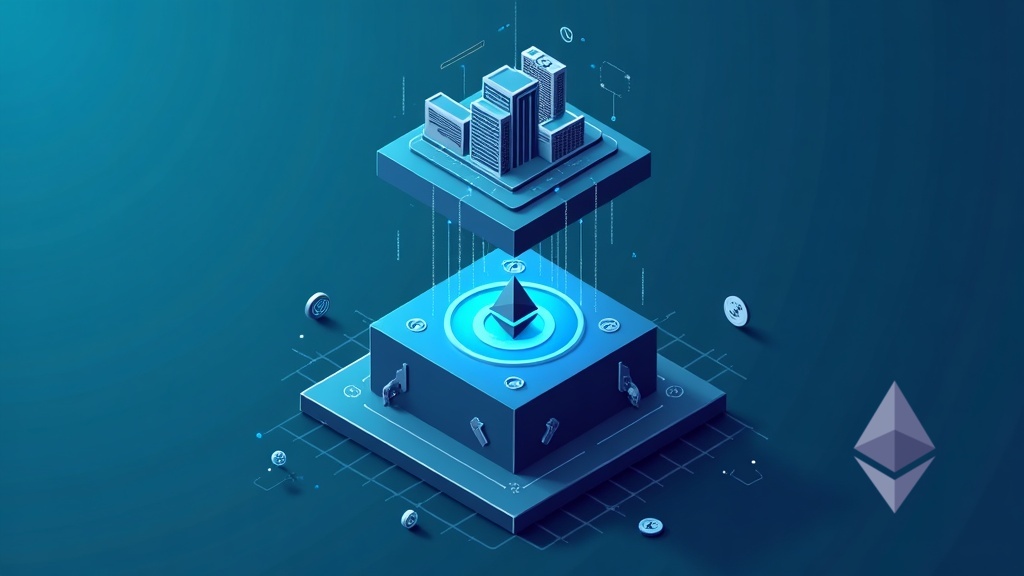
This is by design. The "rollup-centric roadmap" that Ethereum committed to divides labor: L1 does security and settlement; L2s do execution.
The confusion arises because for years, "Ethereum" was marketed as a single computer that does everything. In reality, the network is evolving into a modular stack: L1 at the base, and a growing ecosystem of L2 execution environments on top, each optimized for different trade-offs (ZK vs. optimistic, EVM-equivalent vs. alternative VMs, fast finality vs. maximum decentralization).
Why the "Identity Crisis" Is Misleading
The PYMNTS headline and the EF budget cuts both point to a real change — but the framing matters.
The Ethereum Foundation's restructuring doesn't mean L1 is failing. It means the Foundation is narrowing its scope. Vitalik Buterin described the goal as moving from a central organization carrying most of the ecosystem's weight toward a model where many independent teams, L2 foundations, and community organizations share the load. He has repeatedly framed Ethereum's goal around being a global, censorship-resistant, permissionless blockchain — properties of the protocol, not of the Foundation.
Ethereum does not depend on a single foundation-run server or client team, though Foundation changes can still affect funding, coordination, and roadmap execution. The consensus layer runs on independent client teams (Prysmatic Labs, Sigma Prime, Teku team, Nimbus team). The execution layer runs on independent client teams (Geth team, Nethermind, Besu, Erigon). The Foundation funded much of this early work, but the clients have long since grown into independent open-source projects with diverse funding sources.
The "identity crisis" is about the organization, not the protocol. Ethereum's L1 has a very clear identity: it is a settlement and data availability layer for a multi-chain execution ecosystem. That identity is working — L2 TVL and transaction counts have grown substantially through 2025 and 2026.
What This Means for Users
If you hold ETH or use Ethereum L2s, the distinction matters:
- ETH's utility on L1 is to pay transaction gas on the execution layer and as the staking asset that backs validator security. Validators earn protocol rewards for correct participation; block proposers may also receive transaction priority fees.
- ETH's utility on L2s is as gas for transactions, as collateral in DeFi, and as the native asset bridging between layers. Many users may increasingly interact with ETH on L2s, where transactions are often cheaper and faster than on L1.
- L1 failure modes are rare and catastrophic (consensus attacks, deep reorgs). L2 failure modes are more varied but isolated (sequencer downtime, proof challenges, bridge exploits) and don't corrupt L1.
This separation is not a bug. It is the modular specialization that lets Ethereum scale. The network doesn't need to be "one computer." It needs to be a secure foundation that many computers can trust.
The Bottom Line
Ethereum's L1 knows exactly what it is: a security layer, a settlement layer, and a data availability layer for a growing ecosystem of execution environments. The Foundation restructuring and developer churn are real events, but they don't change the protocol's job description.
The real question is not "What is Ethereum?" — it's "What should a Layer 1 do in a modular world?" And the answer, increasingly, is: less, but better. Less execution, more security. Less monolithic design, more specialized trust.
That shift is uncomfortable for anyone who remembers "World Computer" branding. But it's also the reason Ethereum remains one of the most important L1s for DeFi, NFTs, and rollups — not in spite of the specialization, but because of it.
This article is for informational purposes only and does not constitute financial or investment advice. Always do your own research before engaging with any protocol or token.