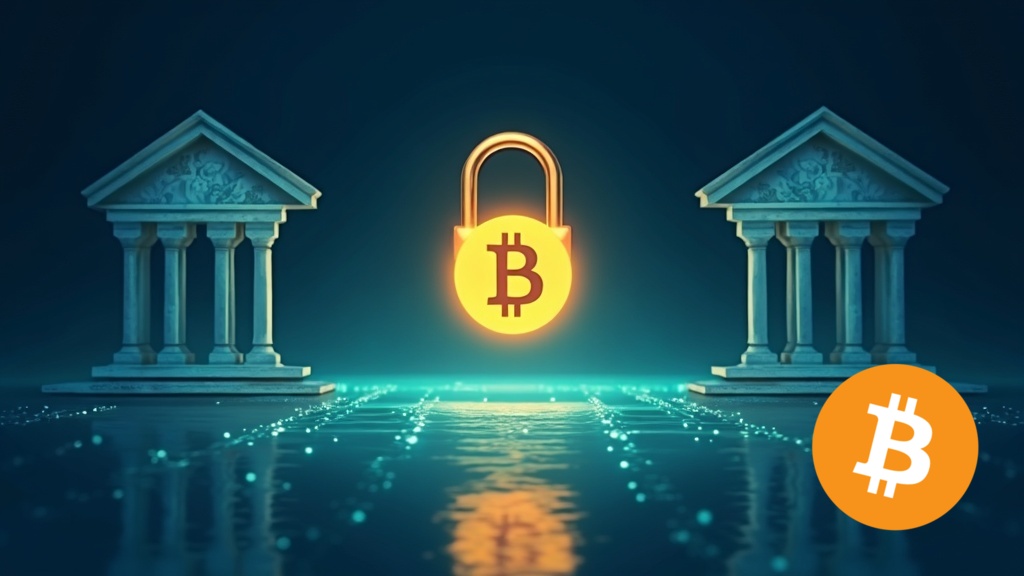
If you've been following crypto news recently, you may have noticed something unusual: BlackRock, one of the world's largest asset managers, is now one of the biggest names in Bitcoin.
But here is the twist — BlackRock's Jay Jacobs recently said that spot Bitcoin ETFs are pulling crypto-native investors into traditional finance, not just pulling TradFi money into crypto. The adoption story is running in both directions.
This guide explains how Bitcoin ETFs work as a bridge between two worlds, what BlackRock's "Great Convergence" really means, and why this matters even if you have never bought a share in your life.
What Is a Bitcoin ETF?
An ETF/ETP (Exchange-Traded Fund / Exchange-Traded Product) is designed to provide exposure to an underlying asset and trades on a regulated stock exchange — just like a regular stock. Commonly called spot Bitcoin ETFs, these products are exchange-traded commodity trusts/ETPs that seek to track Bitcoin's price by holding real BTC with a qualified custodian.
This means you can get Bitcoin exposure through your standard brokerage account, IRA, or retirement fund, without ever touching a crypto exchange, wallet, or private key.
Important distinction: when you buy a spot Bitcoin ETF share, you do not own the underlying Bitcoin directly. The trust primarily holds Bitcoin with a custodian, while shareholders own trust shares that provide similar Bitcoin price exposure, less fees and subject to product-specific tracking differences. You cannot redeem your shares for actual Bitcoin and send it to a personal wallet.
Key features of spot Bitcoin ETFs:
| Feature | What It Means |
|---|---|
| Regulated | Subject to SEC securities-market rules and disclosures; traded on major U.S. exchanges such as Nasdaq, NYSE Arca, or Cboe |
| Liquid | Buy and sell during regular U.S. market hours like any stock |
| Custodied | Bitcoin is held by a qualified custodian (e.g. Coinbase Custody) |
| Tax-simple | Brokerage reporting may be simpler than direct crypto activity, but spot bitcoin ETPs can have product-specific tax reporting details; investors should review the issuer's tax documents |
| Accessible | Often available, depending on broker/account/plan rules |
The Bridge: How ETFs Connect Two Worlds
Before U.S. spot Bitcoin ETPs were approved in early 2024, buying Bitcoin directly usually meant using a crypto exchange or managing wallet/custody choices. Institutional investors — pension funds, endowments, insurance companies — largely stayed out because of compliance, custody, and operational hurdles.
Spot Bitcoin ETFs changed that significantly:
TradFi → Crypto Direction
Some institutions that had difficulty holding BTC directly gained a more familiar listed-product route through spot Bitcoin ETPs. This is the direction everyone talks about — and it has been enormous. By 2026, U.S. spot Bitcoin ETFs had attracted billions of dollars in net inflows and held a meaningful share of circulating BTC.
Crypto → TradFi Direction (The Surprise)
BlackRock's Jay Jacobs recently highlighted a less-discussed trend: many Bitcoin-native investors who never owned a traditional financial product before are now buying their first ETF — entering the TradFi system through the IBIT (iShares Bitcoin Trust).
Jacobs called this two-way flow the "Great Convergence" — the growing overlap between crypto, decentralized finance, and traditional finance. It is not just Wall Street coming to Bitcoin; Bitcoiners are also discovering the convenience and regulatory familiarity of TradFi products.
What Is BlackRock's "Great Convergence"?
BlackRock's "Great Convergence" refers to the gradual merging of three previously separate ecosystems:
- Traditional Finance (TradFi) — Banks, brokerages, regulated exchanges, ETFs
- Crypto / Digital Assets — Bitcoin, Ethereum, self-custody, DeFi protocols
- Decentralized Finance (DeFi) — On-chain lending, staking, DEXs, yield protocols
According to Jacobs, spot Bitcoin ETFs act as the entry point for both sides:
- A retiree with a Schwab account can buy Bitcoin exposure
- A crypto-native investor who only used DEXs can open a brokerage account to buy IBIT
The convergence is not just about capital flows — it is about infrastructure, regulation, and user expectations blending together. Jacobs also noted that BlackRock recently launched BITA, which seeks monthly income through an actively managed options strategy linked to bitcoin exposure — a product that would have seemed unthinkable in a purely TradFi or purely crypto context just a few years ago.
Why This Matters for Beginners
If you are new to crypto, the ETF bridge is probably the most important structural development to understand:
1. Lower Barriers to Entry
You do not need to learn about wallets, seed phrases, gas fees, or exchange hacks. A Bitcoin ETF in your existing brokerage account gives you similar bitcoin price exposure, less fees, with familiar infrastructure.
2. Retirement Accounts
Spot Bitcoin ETFs may be available in IRAs and in some 401(k) plans if the plan allows ETFs or offers a brokerage window — something self-custodied Bitcoin cannot easily do in most jurisdictions.
3. Institutional Validation
BlackRock, Fidelity, and other multi-trillion-dollar asset managers running Bitcoin ETFs helped make Bitcoin exposure more operationally acceptable for some institutions, while the products themselves remain high-risk. This shifts the long-term narrative in a meaningful way.
4. But You Give Up Custody
The trade-off is important: with an ETF, you do not hold the private keys. The custodian holds the Bitcoin. This matters if your priority is true self-sovereignty — a core value proposition of Bitcoin itself.
5. The Convergence Trend Is Early
If the "Great Convergence" continues, expect more hybrid products: Bitcoin-backed loans from traditional banks, yield-bearing crypto products within IRA wrappers, and TradFi-compatible DeFi access. Understanding the bridge now helps you spot where the industry is heading.
A Quick Comparison: ETF vs Direct Ownership
| Aspect | Spot Bitcoin ETF | Direct Bitcoin |
|---|---|---|
| Custody | Third-party (custodian) | Self (your keys) |
| Trading hours | Regular U.S. market hours | 24/7 |
| Fees | Issuer-specific management fees | Exchange fees, withdrawal fees, and possible on-chain network fees |
| Tax reporting | 1099 (broker-provided) | Self-reported |
| Censorship resistance | Subject to broker/custodian | Stronger user control and censorship resistance, but not absolute |
| IRA eligibility | Often available, depending on broker/account/plan rules | Typically not |
Both are valid approaches. Your choice depends on your priorities: convenience and regulatory simplicity (ETF) vs full sovereignty and 24/7 access (direct).
Common Beginner Questions
Is a Bitcoin ETF the same as owning Bitcoin? Not exactly. You own a share in a trust that tracks similar Bitcoin price exposure, less fees and subject to tracking differences. You do not own the underlying BTC directly, and you cannot withdraw it to a personal wallet.
Can I lose my Bitcoin in an ETF? You face counterparty risk (the custodian or broker). However, major issuers like BlackRock and Fidelity use institutional-grade custody. The regulatory structure also adds protections not present on some crypto exchanges.
Do I need a crypto wallet to buy a Bitcoin ETF? No. You typically buy it through a brokerage account that offers access to that ETF — just like buying Apple or Tesla stock.
Which Bitcoin ETFs are available? Major U.S. spot bitcoin ETP issuers include BlackRock, Fidelity, Ark/21Shares, Bitwise, and others; check current issuer or market data for AUM rankings.
The Bottom Line
Bitcoin ETFs have become the most important bridge between traditional finance and the crypto economy — moving capital, people, and infrastructure in both directions. BlackRock's "Great Convergence" thesis captures this trend: what was once two separate worlds is increasingly a single, integrated financial system.
For beginners, the ETF route offers the simplest on-ramp: no wallets, no seed phrases, no exchange anxiety. But it comes with trade-offs — custody, trading hours, and management fees that do not apply to self-custodied Bitcoin.
Understanding both sides of this bridge is the first step to making an informed choice about how you want to participate.
Disclaimer: This article is for educational and informational purposes only. It does not constitute financial or investment advice. Cryptocurrency and ETF products carry risks; do your own research before making investment decisions.